

Marketing Consistency for Wedding Professionals: Why Posting Isn’t Enough
You’ve probably heard that consistency is the key to marketing your business. And you believe it because you’re smart, plus the data backs it up. So you sit down, batch write your captions, schedule your posts, and show up in the social media feed week after week.
But something still feels off. Inquiries are unpredictable. Revenue is inconsistent. You’re doing the work, but you’re not seeing the results you expected from it.
Here’s where your approach has very good intention but isn’t actually what you need. Because the truth is, posting consistently and marketing consistently are not the same thing. Not even close.
Posting on Social Media is One Tactic. Marketing is More Than Just Instagram.
Think about everything that actually makes a client hire you: they find your website, they read your blog, they get your emails, they see your work shared in a membership group, they get a referral from someone who loved working with you. Social media might be part of that journey, but it’s never the whole story—and it’s almost never the thing that made someone decide to inquire.
When small business owners talk about “being consistent,” they almost exclusively mean on social media. And being consistent on social media is absolutely worth doing. But it’s one channel in what should be a broader marketing ecosystem that includes other marketing channels because you don’t want to have all your marketing eggs in one basket.
The problem is that when social media is your whole marketing plan, you end up spinning on a treadmill. You’re working hard, but you’re not necessarily moving toward your goals because you’re marketing by accident most days.

When Your Social Media Posts Point in Every Direction, Nothing Lands
Another issue with confusing consistent posting with consistent marketing is that your content can still feel wildly unfocused.
When there’s no documented plan behind the content, each post is essentially a standalone event—a little spark that doesn’t connect to anything. You might post about your process on Monday, a trend you love on Wednesday, and a throwback on Friday. It’s regular. It’s on-brand, even. But if a potential client binge-reads your last 12 posts (yes, serious potential clients read your captions), are they getting the important information they need to make a decision? Do they understand what makes you different? Does every piece of content work together to move someone closer to booking? Or is every post a quote from a love poem, a wedding date, and a list of vendors?
Consistency without direction is just noise that shows up on a schedule.
And according to Enji’s 2025 State of Small Biz Report (which surveyed 245 small business owners), when asked what one thing they know they should be doing but aren’t, the #1 answer was consistency. And yet only 6% of small business owners say they always complete their planned marketing tasks. So most small business owners are trying to be more consistent. Almost no one actually is.

The Real Consistency Problem You Have With Marketing (It’s Not What You Think)
Here’s something the data shows that can actually help you get more consistent (and strategic) with your marketing: small business owners with a documented marketing plan are 3x more likely to say their marketing is effective and 3x more likely to actually follow through on what they planned.
Read that again. Three times more likely to follow through.
But 75% of small business owners don’t have a documented marketing plan. That means the majority of business owners who are struggling with consistency aren’t struggling because they lack discipline or motivation. You’re (making an assumption that this hits home if you’re still reading) struggling because your plan either doesn’t exist or pieces of it live in 7 different places. And to top it off, those partial plans and collections of ideas are not in the same places you would actually do the work. It’s all in a different doc, a different app, or just floating around in your head.
When your marketing plan is disconnected from where you do the work to check those to dos into to done’s, you end up doing whatever feels most urgent instead of what will actually move the needle—and in whatever direction is sitting right in front of you at the time. You’re not doing the things that will help you reach your goals, communicate your value, and get potential the information they need to make a decision about you.
And in a wedding business, where you’re also doing the client work, answering inquiries, managing timelines, and trying to have a life—”whatever feels good right now” almost never includes the blog post that was supposed to go out or the email sequence you’ve been putting off for three months.
The result? Posting when inspiration strikes, going quiet when life gets busy, and wondering why your marketing feels so inconsistent even though you’re “always on Instagram.”
What Marketing Consistency Actually Looks Like for Wedding Pros
Real marketing consistency is what happens when your plan and your to-do list are the same thing. That means your social media posts take your marketing funnel into consideration. It also means your email list hears from you regularly, not just when you have a date on your calendar you’re trying to fill last minute. It means your blogs are actually getting published (on top of being optimized for search)—not living in a Google Doc labeled “draft to finish later.” And it means your referral relationships are being actively maintained, not just hoped for.
These things don’t happen by chance. They happen by being intentional with your marketing planning — and specifically, through having a place where your marketing plan lives in the same place as what you task yourself with and in the same place you’re drafting and scheduling content.
Organizing Your Marketing in Too Many Places Costs You. Doing it in Even More is Extra Expensive.
We already talked about how 44% of small business owners said consistency as the #1 thing they know they should be doing but aren’t. Not “posting on Instagram consistently”. Marketing consistently. Email. SEO. Relationship-building. All of it.
And the businesses that manage to get that done? They don’t do it by posting more or buying another course or starting to use those templates they already have. (Though you should use the things you buy!) They do it by treating marketing like the important business responsibility it is— with a plan that connects goals to tactics, and a system that makes it easy to actually get the work done.
That’s the difference between the wedding pro who seems like she has a full marketing team behind her and the one who is talented and hardworking but somehow can’t get her marketing to happen.
It’s not an actual easy button. But it’s using tools that make it feel that way and changing your approach to marketing as a whole.

One Place for Marketing Planning and Doing Makes All the Difference
If your marketing plan lives in one place and your to-do list lives somewhere else, it will just be harder for you to check those tasks off as complete. Because the tab switching alone slows you down…if not straight up leads you down an unproductive rabbit hole all together.
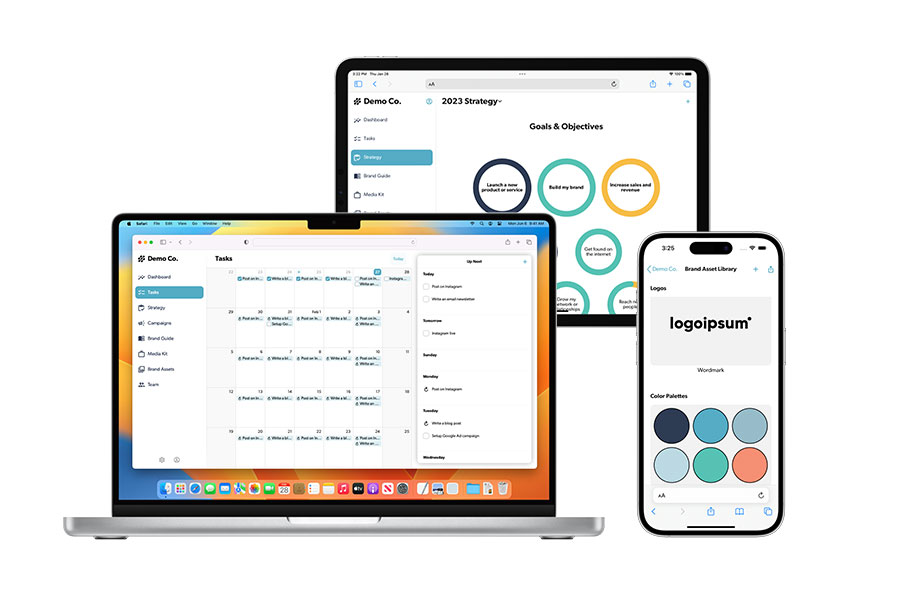
Enji is the only project management tool built specifically to bring your marketing planning and doing into the same place. Because you shouldn’t just be thinking about all the ways you can do a better job with your marketing—you should do them!
Enji can build your marketing plan, create the tasks that ladder up to your goals, schedule them into your calendar, and help you check them off—all without switching between apps or losing track of what you’re supposed to be working on. Because when planning and doing live in the same place, you stop moving things to “next week” and start actually getting them done.
So if you’re a wedding pro who’s been posting consistently but still wondering why your marketing doesn’t feel like it’s working, this is the shift worth making.
Consistent posting is a good habit. But marketing consistently (across multiple channels, toward your goals, without letting weeks go by in silence) that’s what actually gets you leads that fill your calendar. And that starts with a marketing plan that doesn’t just live in your head.
Ready to stop treating marketing like something that happens when you have time? Start your free trial of Enji and see what it feels like to have your marketing plan and your marketing tasks in the same place.
Tayler Cusick Hollman
Tayler Cusick Hollman is a marketing consultant turned small business champion and the founder of Enji, a project management platform designed to help you stop just thinking about doing your marketing and actually get it done. After more than a decade working alongside small business owners, Tayler recognized a common challenge: it wasn’t just knowing what to do—it was getting marketing done consistently. She built Enji to solve that problem. And by being one place you can plan and do your marketing, Enji helps small business owners turn ideas into finished tasks that make them money.



Be the first to comment