

How to Attract High-End Clients (Without Feeling Pushy or Salesy)
How to attract high-end clients is one of those questions that comes up again and again in conversations with wedding and creative professionals.
Usually, it sounds something like this:
“I know my work is good.”
“I’ve invested in my brand or website.”
“But I’m still attracting price-focused inquiries… or I’m not converting the right people.”
That’s exactly why I was so excited to have Maria Bayer on the podcast.
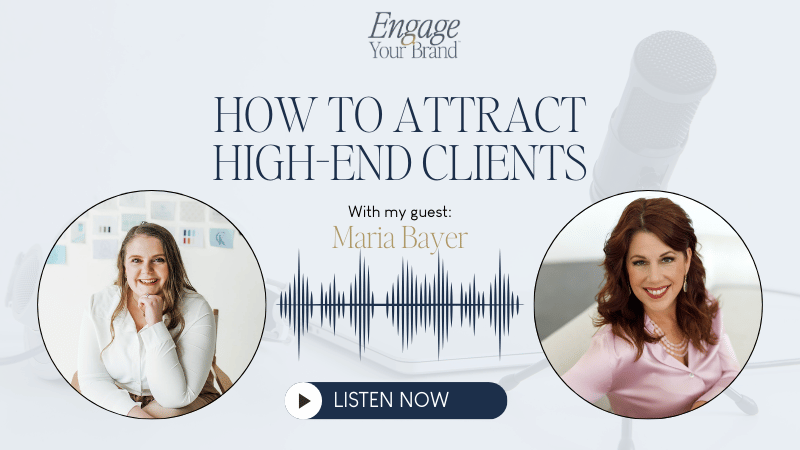
Maria is a high-ticket sales and mindset strategist who works with established service-based business owners, including wedding and event professionals, creative agencies, venues, and coaches. Her approach to sales is rooted in psychology, integrity, and connection, not pressure or chasing. And after being part of her Irresistible Selling program myself, I knew this conversation would be incredibly valuable for anyone looking to elevate their clientele.
Because here’s the truth: attracting high-end clients isn’t about convincing people to spend more money. It’s about alignment. Between your brand, your messaging, your pricing, and your sales experience.
🎧 Listen to this episode on Spotify or Apple Podcasts or play it directly below.
Why sales doesn’t have to feel “icky”
One of the biggest myths in the creative industry is that sales has to feel uncomfortable.
So many of us come into this work because we love creativity, connection, and service. We don’t want to feel like we’re pushing people or talking them into something they don’t want. And for a lot of creatives, that discomfort becomes a barrier to growth.
What I love about Maria’s perspective is that she reframes sales entirely.
Sales isn’t about persuading someone. It’s about guiding a conversation to see if there’s a mutual fit. When you approach it that way, everything shifts. The energy is calmer. The conversation feels more human. And clients feel seen instead of sold to.
This is especially important in luxury and high-end markets, where people are not just buying a service. They’re buying an experience, trust, and peace of mind.

The quiet confidence behind high-end sales
One of my favorite moments in this conversation was when Maria shared how her earliest lessons in sales came from watching her father.
He sold insurance, but never in a stereotypical way. He built relationships rooted in care, integrity, and long-term trust. He took care of people. So much so that he insured multiple generations of the same families.
That kind of selling is quiet. It’s confident. And it’s incredibly effective.
High-end clients are not looking for someone who’s loud, flashy, or overly persuasive. They’re looking for someone who feels grounded, capable, and trustworthy. Someone who understands what matters to them.
And that starts with how you communicate.
Why beautiful branding alone doesn’t convert high-end clients
This is something I see all the time in my work.
A business invests in elevated branding or a new website because they want to attract a higher level of client. The brand looks beautiful. The visuals feel refined. The messaging is aspirational.
But behind the scenes, the sales process hasn’t changed.
They’re still selling the same way.
Using the same language.
Quoting prices the same way.
Focusing on features instead of outcomes.
And that’s where the disconnect happens.
High-end clients buy differently. They’re less concerned with line-item breakdowns and more concerned with experience, exclusivity, and trust. If your brand positions you at one level, but your sales experience feels transactional or overly budget-focused, it creates friction.
Clients feel that mismatch immediately.
How pricing psychology plays into attracting higher-level clients
A really important point Maria shared is that money is always a consideration, even for luxury clients. But what they value and how they evaluate value is different.
Think about something in your own life that you’re willing to splurge on. Travel. Food. Experiences. Education. When something matters deeply to you, price becomes contextual. You’re not looking for the cheapest option. You’re looking for the right one.
High-end clients are the same.
When pricing feels too low for something they value highly, it can actually create doubt. Instead of feeling like a deal, it raises questions: Is something missing? Is this person experienced enough? Will this deliver the level of care I expect?
Attracting high-end clients requires pricing that supports the value you’re communicating, not contradicts it.
Signs your brand and sales process are out of sync
If you’re wondering whether this might be happening in your business, there are a few clear indicators.
You might be:
- Getting inquiries, but not converting them
- Booking fewer clients after a rebrand or website launch
- Seeing people drop off before booking calls
- Getting stuck at a pricing plateau
Maria shared that one of the best ways to diagnose this is to look at your sales funnel as a whole. From inquiries, to calls, to proposals, to booked clients. Where are people falling off?
If the leads are coming in but not closing, that’s often a sign the sales experience doesn’t match the brand promise.

Asking better questions instead of selling harder
One of the most powerful tools in attracting high-end clients is simply asking better questions.
Not rapid-fire questions.
Not scripted spiels.
But thoughtful, intentional questions that help clients connect emotionally with what they want.
People make decisions emotionally and justify them logically. When sales conversations stay stuck in features, deliverables, and timelines, clients stay in their logical brain — and that’s where price comparisons live.
Maria shared a story about planning her own wedding that illustrates this perfectly. A vendor focused on small price differences instead of asking why the ceremony mattered to her. One simple question could have completely changed the outcome.
High-end sales aren’t about talking more. They’re about listening better.
Selling outcomes, not just features
This applies not just to sales calls, but to websites and brand messaging too.
Clients don’t just want to know what’s included. They want to know:
- How this will make their experience easier
- What this protects them from
- What this gives them long-term
This is where so many businesses miss opportunities on their websites. They list what they do, but not what it means.
When you communicate outcomes clearly. Whether that’s peace of mind, legacy, confidence, or an elevated experience, you naturally attract clients who value those things.
When a website launches but doesn’t convert
A “flopped” website launch is one of the most stressful things a business owner can experience.
If your site is bringing in inquiries, but those inquiries aren’t turning into clients, the issue usually isn’t design alone. It’s messaging, positioning, or sales alignment.
Are you still speaking to your old client, even though your brand is designed for a new one?
Are you confident in the value you’re presenting, or quietly uncomfortable with your new pricing?
Does your internal mindset match the external elevation?
Sales and branding are deeply connected. When one levels up, the other has to follow.
The mindset shift that unlocks higher-level bookings
One of the most important reframes Maria shared is this: your job is not to book everyone.
Your job is to determine whether you’re a good mutual fit.
That mindset alone removes so much pressure. When sales becomes a conversation instead of a performance, confidence grows naturally. Clients feel that steadiness, and it builds trust.
Another powerful shift is remembering that indecision isn’t neutral. If your process doesn’t guide clients to a clear yes or no, it often leads to chasing — and chasing erodes confidence on both sides.
Clear guidance is a gift.

Why refining your sales process creates fast ROI
Sales is one of the few areas of your business where small shifts can create immediate results.
The longer you delay refining how you sell, the more opportunities you step over — higher packages, better-fit clients, stronger alignment.
Maria shared that many of her clients recoup their investment quickly because sales improvements show up right away. And once cash flow improves, it becomes much easier to invest in branding, websites, and long-term growth.
Sales fuels everything else.
Branding, sales, and attraction working together
One of the reasons I love this conversation is because it reinforces something I believe deeply: your brand should do heavy lifting for you.
A strong brand warms people up before they ever reach out. It sets expectations. It filters. It attracts the right people, and gently repels the wrong ones.
But for that to work, your sales experience has to carry the same energy. The same clarity. The same confidence.
When branding and sales are aligned, clients arrive already feeling like, “This might be my person.”
And from there, the conversation feels easy.
Final Thoughts
If you’ve been wondering how to attract high-end clients, the answer isn’t working harder or becoming someone you’re not.
It’s about alignment.
Aligning your mindset with your value.
Aligning your brand with the clients you want to serve.
Aligning your sales process with how people actually make decisions.
High-end clients are not looking to be convinced. They’re looking to feel understood.
If you want support refining your brand, messaging, or website so it attracts and converts the right clients, this is exactly the work we do at Emily Foster Creative. From brand strategy and website design to audits and ongoing support, everything we create is designed to help your business grow with intention.
You can explore our services or get in touch at emilyfostercreative.com.
And if you haven’t yet, be sure to listen to this episode with Maria Bayer. It’s full of perspective shifts that can completely change how selling feels in your business.
You don’t need to chase the right clients.
You just need to meet them where they already are.



Be the first to comment