

Wedding Planner Tips: Building a Business on Your Own Terms
Wedding planner tips usually come in one flavor: do more. Post more often, show up on more platforms, add another offer, chase the next trend. And if you run a creative business in the wedding industry, you’ve probably felt the quiet pressure that comes with that advice. There’s always another place you’re supposed to be, another thing you’re supposed to be doing, and very little room to ask whether any of it actually fits the way you want to work.
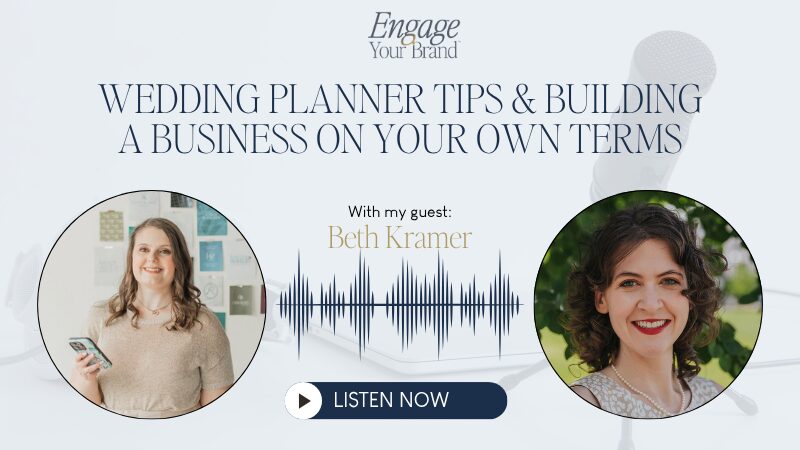
That tension is exactly why I was so excited to sit down with my good friend Beth Kramer. In this episode of Engage Your Brand®, Beth shares how she built her Portland wedding planning business, why she stepped away from Instagram in 2023, and how writing, community, and intentional offers became the backbone of her work. Beth was one of the first friends I made in the wedding industry, and our conversations always leave me thinking more clearly about what it means to build a business that reflects your values.
🎧Listen to this episode on Spotify or Apple Podcasts or play it directly below.
Whether you’re a planner, photographer, florist, venue owner, or designer, the lessons from this conversation apply well beyond wedding coordination. Let’s dig into what Beth has learned and how you can apply it to your own business.
How Beth Kramer Became a Wedding Planner (Almost by Accident)
About ten years ago, Beth was working full time as a magazine editor when a couple of friends asked her to be their day-of coordinator. She had no idea what that role involved. Her main reference point, as she joked, was the movie The Wedding Planner. Still, she said yes, because that’s what you do when friends are getting married.
During the reception, both the photographer and the florist came up to her separately and asked for her business card. Beth didn’t have one. She wasn’t a planner. They told her she should think about it, because she was good at it and people would pay for that.
A few months later, she launched a simple Squarespace website and started taking weddings on weekends while still working in journalism. After two years, she and her now-husband moved from Seattle back to Portland, and in 2018 she went full time. Today she runs her planning and consulting business, wrote a wedding planning workbook called Modern Etiquette Wedding Planner, and leads Altared, a space for wedding vendors who want to change the wedding industry.
What stands out about Beth’s story is that she never built her business by copying the standard playbook. She built it around her own strengths, and that thread runs through everything she shared.
Start With the Why Behind the Wedding
One of the most valuable wedding planner tips Beth offers has nothing to do with timelines or vendor lists. It’s about intention. When a publisher approached her to write her book, she had roughly six to eight weeks to complete it. Rather than produce another traditional etiquette guide full of outdated rules, she created a workbook that couples could actively write in and engage with.
The first third of the book focuses on what Beth calls the soul-searching work. Couples are invited to write a mission statement for their wedding and to have real conversations with each other about why they’re doing this at all. The how-tos and checklists come later. As Beth put it, she’s a Virgo wedding planner who loves a list, but the lists only matter once you know what you’re building toward.
Why does this matter so much? In Beth’s experience, regret almost always comes from a lack of intention. Couples spend money and energy on things simply because they’re expected, not because those things mean anything to them. Weddings serve a very different purpose in Western culture than they once did, and helping couples feel grounded before they start booking is one of the kindest things a wedding pro can do.
If you want to bring more intentionality into your client experience, consider weaving a few reflective questions into your onboarding process:
- What do you want your guests to feel when they leave? This shifts the focus from aesthetics to experience, which helps prioritize the budget.
- Which traditions feel meaningful, and which feel like obligations? Giving couples permission to let go of something can be a huge relief.
- What would you regret not doing? This question surfaces the details that actually matter most to them.
- Where do you want to spend, and where are you comfortable saving? Naming priorities early prevents stressful budget conversations later.
I see this shift happening across the industry, especially with Gen Z couples. It’s less about proving you can deliver the most perfect, trend-forward wedding day and more about helping people stay present and create something that feels true to them. If your brand messaging speaks to that, it will resonate.
Educate Your Clients Without Overwhelming Them
When I asked Beth about her biggest branding challenge, she pointed to something many wedding pros will recognize. Almost every client she works with has never planned a wedding before, or it’s been decades since they last did. That means a big part of her job is education.
The challenge is finding the line between being helpful and being patronizing. Beth isn’t an inexpensive purchase, and she wants clients to understand the value behind her pricing. At the same time, she doesn’t want to bury them in information before they’re ready.
This is where your website and client experience can do a lot of the heavy lifting. Clear service pages, a thoughtful FAQ, and a welcome guide that explains your process in plain language all help clients understand what they’re investing in. When education is built into the experience, you spend less time repeating yourself and more time actually serving people.
Turn the Questions You Hear Most Into Helpful Resources
Beth’s advice for creating a more inclusive client experience is refreshingly simple. Answer the questions people ask you most often. Then answer the ones you had when you were starting out, because someone else is almost certainly wondering the same thing.
On her website, Beth shares a library of 20 to 30 resources she uses in her own business. They’re linked as editable Google Docs and aren’t hidden behind an email signup. Her reasoning? She was already using these tools in her Google Drive, so why not let other people use them too?
This habit became especially important during the pandemic. At the time, there weren’t clear guidelines about whether weddings were even legal to hold in Oregon, let alone safe. Instagram was full of hearsay, with people repeating whatever a friend of a friend at a venue had told them. So Beth leaned on her journalism background. She attended the Oregon Health Authority’s public virtual press conferences and reported directly on what was legal, updating the article countless times. That piece grew into a suite of roughly 50 COVID-era resources covering vaccination boundaries, masking, venue contracts, and health and safety plans.
I was one of the couples who found those resources. My husband and I got married in 2022, and I was anxious about everything from venue contracts to wildfire season. Beth’s writing helped me feel more prepared, and that’s the real power of this approach. Helpful content builds trust long before someone ever fills out your contact form.
If you’d like to start building your own resource library, here are a few practical places to begin:
- Keep a running list of client questions. Every time someone asks something in an inquiry, consult, or email, write it down. Repeated questions become blog post topics.
- Share the tools you already use. Timelines, checklists, and planning templates can become free resources with very little extra work.
- Source your information carefully. Especially for legal, health, or safety topics, link to the original authority instead of repeating what you’ve heard secondhand.
- Update your most important pieces. A resource that stays accurate keeps earning trust and search traffic over time.
What Happened When Beth Stepped Away From Instagram
In 2023, Beth announced she was leaving Instagram. In an industry where so many people feel they need to be everywhere at once, that’s a pretty rare decision, so I wanted to hear what led to it.
The answer was surprisingly practical. Before leaving for good, Beth took a break of about four to six weeks and then checked her website analytics. There was no meaningful change. From a pure effort-versus-return standpoint, Instagram simply wasn’t driving her business.
There were other factors too. She was tired of seeing inaccurate information spread, especially around health and safety. She felt like she was shouting into a void. And at the end of 2023, she was about to have a baby, which made her think carefully about where she wanted to spend her limited energy. So she stepped away, figuring Instagram would welcome her back if she ever missed it. She hasn’t gone back.
Beth is careful to say her decision isn’t a judgment of anyone else. For many of her photographer friends, Instagram truly is their portfolio, and it makes sense for them to be there. Planners who love the visual side of weddings, like linens, color palettes, and design details, often find the platform energizing. Beth’s strengths have always been logistics and communication, and her best tool is words.

Choose Marketing Channels That Match Your Strengths
So where does Beth show up instead? Her marketing is built almost entirely around written, long-form, and direct communication, which aligns with her background and with how she naturally connects with people.
Here’s what her current marketing mix looks like:
- Her monthly email newsletter. Through her own newsletter, she shares resources for couples actively planning a wedding.
- Reddit. She has hosted multiple AMAs and regularly answers questions in wedding planning subreddits, always following the moderators’ rules.
- Her website and blog. Years of consistent writing mean many clients find her through Google search.
- Email and personal connection. She describes herself as someone who actually replies to email and loves a good pen pal.
I want to pause on the SEO piece, because it’s important. Some wedding pros feel they can’t leave Instagram because they don’t get inquiries from Google. Beth was quick to acknowledge that she has a base many people don’t have. She blogged constantly for years, and that built her search visibility over time. A website doesn’t get found just because it exists. It takes consistent, helpful content.
Beth was also honest that search isn’t perfect either. Like many business owners, she’s seen her Google traffic drop over the past year, and AI tools are scraping much of what she writes. No single channel is a guarantee. That’s exactly why choosing channels that feel sustainable for you matters so much.
A practical way to apply this is to look at your own analytics before deciding where to invest your time. Which platforms actually send traffic to your website? Where do your best inquiries come from? What kind of content do you genuinely enjoy creating? Your answers might confirm that Instagram is the right place for you, or they might give you permission to try something different.
Low-Pressure Offers Build Real Trust
Another part of Beth’s business that grew out of the pandemic is her Rent My Brain consulting service. It’s a one-hour session where couples can talk through anything related to their wedding. Early on, nearly every session focused on health and safety planning. Today, the conversations cover vendors, timelines, budgets, intentions, and sometimes more tender topics. One recent session focused on ways to honor a parent who had passed away, which later inspired one of Beth’s blog posts on grief and weddings.
The results speak for themselves. Beth has a very high rate of consulting clients coming back to book her coordination services, and she doesn’t hard sell during the call. In fact, she tells clients from the start that they don’t need to talk about coordinating at all.
If she isn’t the right fit, she sends a list of coordinators she recommends, the client tells her who they like, and Beth reaches out to check availability. There’s no expiration date on that offer.
There’s a lesson here for any service-based business. A smaller, accessible entry point lets potential clients experience how you work before making a big investment. Think about whether a consult, a strategy session, or a mini offer could give your dream clients that same low-pressure way to get to know you.
Community Doesn’t Have to Be Complicated
Beth’s work with Altared grew out of an event that didn’t go as planned. In 2019, she and a group of local vendors hosted a couple-facing event designed to flip the traditional bridal expo on its head, focusing on the marriage itself with a financial counselor, a marriage counselor, and a panel of married couples. Couples didn’t attend in large numbers, but Beth noticed the most interesting conversations were happening between vendors who shared similar values.
In February 2020, the first version of Altared launched. Since then, it has taken many forms, including Q&As with educators, a care package sent to 50 vendors during the pandemic, a Slack channel, and a pen pal program. Today, it includes a monthly newsletter of resources centered on diversity, equity, inclusion, accessibility, and belonging, along with free quarterly meetups led by volunteer hosts in cities like Seattle, Philadelphia, and New York.
The meetups are simple. Vendors gather at a coffee shop for an hour and talk. People sometimes arrive unsure whether to bring business cards or swap handles, and Beth’s response is that they can, but the real point is just to connect. Many attendees tell her it’s their favorite networking event. As she said with a laugh, she didn’t invent the coffee shop, but she’s glad people like it.
Much of the wedding industry can feel pay-to-play, and there’s only so much money a small business owner can spend on memberships and events. Free, low-pressure connection fills a real gap. If you’ve been craving more community, you don’t need to wait for the perfect event. Inviting a few local vendors for coffee is a meaningful place to start.
It’s Okay to Be in Maintenance Mode
One of my favorite parts of this conversation was Beth’s honesty about where her business is right now. She’s the primary caregiver for her two-year-old daughter during the week, so she’s intentionally keeping things steady rather than chasing growth. She’s serving a smaller season of clients, writing when a topic feels worth exploring, maintaining both newsletters, and keeping the Altared meetups going.
She described it as a kind of stasis mode. It isn’t flashy, but it keeps everything running so it’s there when she has more capacity to give.
There’s so much pressure in business culture to always be scaling. Beth’s approach is a good reminder that seasons change, and a business built around your life can flex with it. Maintaining what you’ve built is a valid strategy, especially when your foundation is strong.

Build a Brand That Works the Way You Do
If Beth’s story has you rethinking where you spend your marketing energy, your brand and website play a big role in making that shift possible. When your website clearly communicates your values, educates your clients, and is built with SEO in mind, it can carry more of the load so you don’t have to be everywhere at once.
At Emily Foster Creative, we help wedding pros and creative business owners build brands, websites, and SEO strategies that reflect how they actually want to work. If you’re ready for a website that supports your business instead of draining your energy, we’d love to hear from you.
Building a Business on Your Own Terms
Beth’s story is a reminder that there’s no single right way to build a wedding business. She started by saying yes to helping friends, grew her business through writing and genuine generosity, stepped away from a platform that wasn’t serving her, and created community through something as simple as a coffee meetup.
The best wedding planner tips aren’t really about doing more. They’re about being intentional, both with your clients and with yourself. When you understand your strengths, answer the questions your clients are already asking, and choose marketing that gives you energy, you can build a business that feels sustainable for the long haul.
To connect with Beth, visit her website, sign up for her newsletter, or learn more about Altared. And as Beth would tell you, she’s someone who actually replies to email.


Be the first to comment