

Work Life Balance for Wedding Professionals: How to Run Your Business Like a CEO
Work life balance for wedding professionals is often framed as a personal responsibility instead of a business design issue. Advice usually focuses on better time management, stronger boundaries, or learning how to say no, implying that exhaustion is something you should be able to fix if you just tried harder.
That framing misses the real problem.
Most wedding businesses were never structured to support balance in the first place. They were built to survive peak season, respond quickly, and accommodate clients at all costs. Over time, those expectations quietly retrain business owners to normalize exhaustion.
Eventually, constant work starts to feel like proof that you care.
This conversation on Engage Your Brand® challenges that belief.
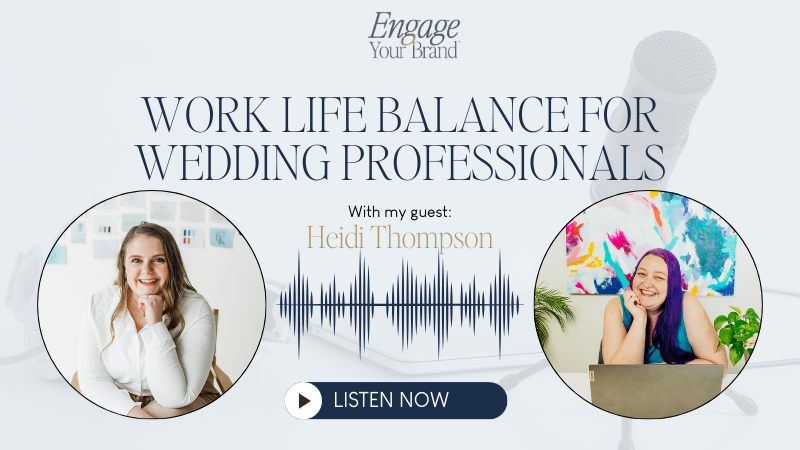
In this episode, I sat down with Heidi Thompson, a wedding business coach, strategist, and creator of the Wedding Business CEO Summit to talk about what actually happens after you book clients. Because while bookings are often the goal, they’re also where many wedding professionals begin to unravel.
What follows isn’t a productivity checklist. It’s a reframing of how work, success, and sustainability function inside a creative service business.
🎧 Listen to this episode on Spotify or Apple Podcasts or play it directly below.
Why the Wedding Industry Quietly Rewards Overwork
The wedding industry is emotionally charged by design. Clients are planning one of the most meaningful days of their lives. Timelines are fixed. Expectations are high. The stakes feel deeply personal.
Inside that environment, availability often gets mistaken for professionalism.
Fast replies become assumed. Late-night work turns routine. Weekend boundaries dissolve. Calendars fill faster than they clear.
Over time, exhaustion stops registering as a warning sign and starts feeling like responsibility.
That normalization is dangerous.
Burnout rarely arrives as a dramatic collapse. More often, it shows up quietly disguised as dedication.
Burnout Is Often Functional, Not Explosive
One of the hardest things about burnout is that you can still perform while experiencing it.
Clients remain happy.
Deadlines are met.
Income continues.
Internally, however, things feel heavier.
Creativity becomes harder to access. Decision-making feels draining. Emotional bandwidth shrinks. Joy fades into obligation.
Early signs often include:
• Difficulty concentrating for long stretches
• Mental fog even after rest
• Irritation toward normal client requests
• Getting sick once busy seasons end
• Resentment toward work you once loved
None of this means you’re bad at business.
It means your business structure is asking more than it can sustainably give.
Work Life Balance Is a Design Problem, Not a Discipline Problem
This is where the conversation shifts.
Balance doesn’t come from trying harder or managing time more aggressively. No amount of discipline can fix a system built on constant urgency.
Heidi shared that most wedding professionals don’t have a time problem, they have a prioritization problem created by unclear systems.
When everything feels important, nothing actually is.
CEO thinking begins when you stop asking how to fit more into your week and start asking what should never have been there in the first place.
The Technician Trap: Why Growth Makes Things Worse Without Structure
Most wedding professionals begin as technicians.
A craft gets learned first.
Service delivery follows.
Payment comes from execution.
As the business grows, that identity becomes limiting.
Instead of doing less hands-on work, many owners simply stack more responsibility on top of it. Marketing, sales, admin, client management, social media, accounting—all layered onto the same person.
The result is a business where the owner is responsible for everything and supported by very little.
A CEO doesn’t operate this way. CEO mode isn’t about doing more efficiently. It’s about deciding what deserves your time at all.

Viewing Your Business Through an ROI Lens
One of the most actionable ideas Heidi shared was evaluating work through return on investment, not habit.
Every task in your business costs something:
- Time
- Energy
- Attention
- Focus
Many wedding professionals are shocked to discover how much of their week is spent on tasks that don’t meaningfully contribute to bookings, revenue, or client experience.
These activities often continue simply because they’ve always been done.
When Heidi works with clients, it’s common for them to free up five to eight hours per week almost immediately without revenue loss by removing low-impact work.
Nothing breaks.
Clients don’t complain.
Sales don’t drop.
Capacity returns.
The Question That Instantly Creates Clarity
There’s one question that consistently reveals what actually matters:
If you could only work ten hours a week, what would you keep?
That exercise exposes how much effort is tied to perceived busyness rather than necessity. Most businesses rely on far fewer activities than owners believe.
Everything else exists by default.
Why Staying Busy Feels Safer Than Being Strategic
Action feels comforting. Movement creates the illusion of progress.
Many wedding professionals stay busy because stillness feels risky. Slowing down forces reflection, and reflection raises uncomfortable questions about what’s actually working.
Heidi shared a powerful analogy: digging ten holes with a spoon versus digging two holes with an excavator.
Both require effort.
Only one produces results.
Strategic work often feels slower at first because it requires decision-making instead of reaction.

Context Switching Is Quietly Destroying Focus
Another major contributor to exhaustion is constant task switching.
Jumping between emails, proposals, timelines, DMs, meetings, and notifications fractures attention. Each switch carries a cognitive cost.
Research now shows it can take more than 20 minutes to fully regain focus after an interruption.
Scattered days don’t just feel exhausting, they reduce output.
Meetings Are One of the Biggest Hidden Time Drains
Between inquiry calls, consultations, client check-ins, vendor coordination, walkthroughs, and team conversations, meetings can quietly take over entire weeks.
Without structure, calendars fragment.
Call Days Create Mental Relief
Designating specific days for meetings protects space for deep work and lowers cognitive load.
Limited Booking Windows Preserve Energy
Wide-open calendars feel flexible but often lead to constant interruption. Narrow windows create structure without sacrificing service.
Shorter Meetings Improve Outcomes
Many conversations don’t require an hour. Shorter calls often lead to clearer decisions and less fatigue.
Asynchronous Communication Reduces Load
Emails, recorded walkthroughs, and structured forms can replace meetings entirely—without sacrificing clarity.

Working Fewer Hours Can Increase Revenue
This idea challenges deeply ingrained beliefs.
When time is limited, priorities sharpen. Busywork loses appeal. High-impact activities rise to the top.
Many wedding professionals find that reducing hours actually increases profitability because effort becomes focused instead of scattered.
Less time forces better decisions.
Gen Z Is Changing How Couples Book Vendors
Client behavior directly affects workload.
Gen Z couples approach booking differently:
• Extensive research before inquiring
• Heavy reliance on reviews and proof
• Low tolerance for friction
• Expectation of modern systems
• Fast decisions once clarity exists
Referrals still matter, but they’re no longer automatic yeses. Couples verify everything.
Unclear messaging, clunky websites, and vague offers create more friction and more back-and-forth work for you.
Traditional Booking Timelines Are Breaking Down
Engagement season no longer guarantees immediate inquiries.
Couples are booking later.
Decisions happen faster.
Weekday weddings are rising.
Inquiries arrive closer to event dates.
Businesses must remain ready year-round instead of relying on outdated seasonal assumptions.
Specificity Is the Fastest Way to Reduce Overwhelm
The businesses thriving right now share one trait: clarity.
Clear positioning attracts aligned clients and filters out poor fits before conversations begin. When messaging is specific, boundaries hold naturally.
If your website copy could be swapped with another vendor’s without anyone noticing, potential clients won’t notice either.

Systems Protect Balance Better Than Willpower
Boundaries matter, but systems enforce them.
Automation, workflows, templates, and defined processes reduce decision fatigue. Fewer decisions mean more energy for creative and strategic work.
Sustainable businesses don’t rely on constant self-control.
The Hidden Emotional Labor No One Talks About
Beyond deliverables, wedding professionals carry enormous emotional weight.
Clients navigate family dynamics, finances, expectations, and stress. Vendors often become mediators, therapists, and anchors—while remaining calm and professional.
That labor drains energy even when tasks are complete.
Ignoring emotional capacity leads to exhaustion that no calendar fix can solve.
Balance Is a Business Choice
Work life balance for wedding professionals isn’t about caring less.
Intentional care looks different.
A sustainable business chooses clarity over chaos, structure over reaction, and strategy over survival.
Redesigning how you work is allowed.
Protecting your energy is part of leadership.
Operating as a CEO is not optional at this stage of growth.
What Sustainability Actually Looks Like in Practice
Sustainable businesses rarely change through dramatic overhauls. Progress comes from quieter decisions made consistently.
Noticing which tasks drain you fastest is information, not failure.
Paying attention to how your body feels after work matters.
Recognizing that success shouldn’t require constant recovery is growth.
Work life balance for wedding professionals doesn’t come from doing less carelessly. It comes from doing the right things deliberately, inside systems that support both your clients and your capacity.
Intentional design allows urgency to soften.
Clear priorities stop energy from leaking everywhere.
Built-in structure makes rest possible without guilt.
Running your business like a CEO doesn’t mean distancing yourself from your work. It means creating a framework where your creativity, expertise, and time are protected instead of consumed.
If you’re ready to evaluate how your business supports your life—not just your workload—explore the conversations, resources, and strategic support available at Emily Foster Creative.
Growth does not have to cost you your well-being.
Sustainability is something you can choose, on purpose.
Ready to Build a Business That Supports You?
If this conversation resonated, the next step isn’t working harder. It’s learning how to run your business with clarity, systems, and support instead of constant urgency.
One of the most impactful ways to do that is through the Wedding Business CEO Summit hosted by Heidi Thompson.
This summit is designed specifically for wedding professionals who have already booked clients and now need their business to function sustainably. Conversations focus on prioritization, systems, time protection, CEO-level decision making, and removing work that no longer serves your growth.
Rather than adding more to your plate, the summit helps you identify what can be simplified, automated, delegated, or removed entirely—without sacrificing income or client experience.
If you’re feeling stretched, reactive, or unsure how to support your next level of growth without burning out, this is a space worth paying attention to.
→ Learn more and register for the Wedding Business CEO Summit
And if you’re ready to go deeper into how your brand, messaging, and systems support (or sabotage) your work life balance, there’s space for that too.
At Emily Foster Creative, we help wedding professionals design brands and websites that attract aligned clients, reduce friction, and support a business model built for longevity—not constant recovery.
Thoughtful positioning creates clarity.
Clear systems protect capacity.
Aligned brands make balance possible.
→ Explore resources and strategic support at Emily Foster Creative


Be the first to comment